


Early puberty in girls is a question more parents are bringing into pediatric exam rooms as more girls show signs at age 8 or younger. The trend is most pronounced among Black girls, making this a conversation thousands of parents are having with pediatricians right now.
Key Takeaways
- Call About Early Signs. Ask your pediatrician about breast development before 8 or periods before 10.
- Track The Pace. Write down when changes begin and how quickly they progress.
- Ask About Observation. Many girls may be followed with checkups every 4 to 6 months.
- Keep Hair Care Practical. Use fewer products when possible, rinse as directed, and ventilate.
- Lead With Pride. Tell your daughter her body is worthy of respect and care.
Puberty before age 8 in girls, or breast development between 7 and 8, should be checked by a pediatrician; most cases do not have a dangerous cause. The newest guidance says many girls can be watched with exams every 4 to 6 months instead of having immediate testing.
Get the Monday email + free printables for your child’s age
The week's best articles for parents raising Black children, plus free printables and book picks. One email, every Monday. Sign up and we will send you our two routine charts plus a free printable made for your child’s age, from a hospital bag checklist to a teen phone agreement.
[spacer height="100px"]
What Does Early Puberty In Girls Look Like?
Early puberty in girls can include breast budding, body hair, body odor, acne, a growth spurt, or periods that arrive earlier than expected.
Breast development is often the first sign of puberty. Pubic or underarm hair and body odor may appear too, although hair or odor alone can sometimes be related to adrenal changes rather than the full puberty process. Periods usually begin about two to three years after breasts start developing.
The American Academy of Pediatrics’ guide to precocious puberty defines it as puberty signs before age 8 in girls and before age 9 in boys. It also notes that African American and Hispanic girls may start somewhat earlier on average. A single sign does not tell you how quickly puberty is progressing, so your pediatrician can help interpret what you are seeing.
[spacer height="100px"]
Why Do Black Girls Often Start Puberty Earlier?
Research finds differences in average puberty timing, but race is not a diagnosis or a complete explanation for any one child.
A study cited in 2025 research found that by age 8, 43 percent of Black girls had begun breast development, compared with 18 percent of white girls. A separate large U.S. study reported that the average age at first period fell from 12.5 years among people born from 1950 to 1969 to 11.9 years among those born from 2000 to 2005. Early menarche rose from 8.6 percent to 15.5 percent, with the shift most pronounced among Black, Hispanic, Asian, and mixed-race participants, according to Harvard T.H. Chan School of Public Health.
These are group-level patterns, not predictions about your daughter. Her health history, growth pattern, environment, and pace of change all matter. Successful Black Parenting Magazine encourages you to bring your observations and questions to a clinician who will take your concerns seriously.
In one study, 43 percent of Black girls had started breast development by age 8, compared with 18 percent of white girls. That is not a reason to panic. It is a reason to prepare.
Know a parent who needs this? Send it to them.
[spacer height="100px"]
What Do Stress, Weight And Environment Have To Do With It?
Puberty timing is influenced by many factors, and research points to both body processes and the conditions children live in.
In an April 2026 study, Columbia Mailman School researchers found that girls with higher stress-hormone and BMI measures entered puberty about seven months earlier, on average, than peers with lower levels of those measures. The research studied how stress, hormones, and BMI interacted; it does not mean a parent caused early puberty or that a child is to blame. You can read the Columbia study summary.
A 2025 study also found earlier pubertal timing among Black girls living in states with higher measures of structural racism. The association was comparable in size to BMI in that study, though researchers cannot use it to determine why one individual child starts puberty early. These findings widen the conversation beyond individual choices to include larger systems and environments. Steady routines, supportive relationships, and access to respectful health care can help your child feel secure as you seek answers.
[spacer height="100px"]
Do Hair Products Play A Role?
Some research has raised questions about certain hair products, but the evidence is limited and does not prove that a product caused your daughter’s development.
A small pilot study found that women who recalled using hair oil or relaxers in childhood were more likely to have had their first period before age 12. The researchers noted that the study was limited and called for more research. Another study measured endocrine-disrupting and asthma-related chemicals in hair products used by Black women. You can read the pilot study on childhood hair products and menarche and the study measuring chemicals in hair products.
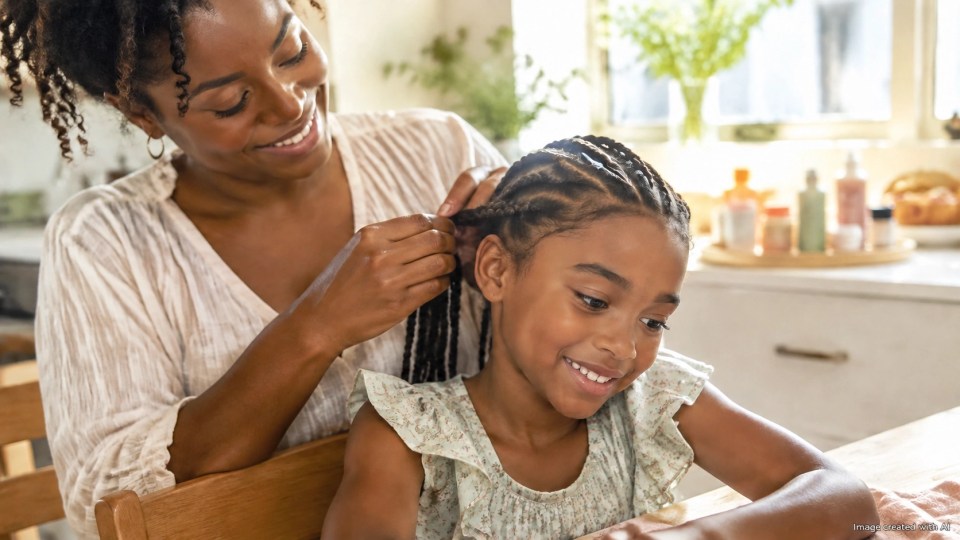
You do not need to give up the hair care traditions that bring you joy. Keep the routine practical: use only the products you need, rinse products out as directed, ventilate the room during use, and avoid products that contain estrogen or placenta. For more culturally informed hair care guidance, visit our Hair and Skin Care guide.
[spacer height="100px"]
When Should You Call The Doctor?
Call your child’s pediatrician about puberty signs before age 8, a rapid change, or symptoms that concern you.
Make an appointment if you notice breast development or pubic or underarm hair before age 8, a period before age 10, or changes that seem to speed up over a few months. Also mention a growth spurt that moves her off her usual growth curve. Headaches or vision changes should be discussed promptly with a clinician. For boys, puberty signs before age 9 also warrant a call.
Before the visit, note when you first saw each change and whether it has progressed. Bring any questions about her growth chart. The National Institute of Child Health and Human Development puberty page offers general background, but your child’s clinician is the right person to assess her specific signs. Our Health and Wellness guide can help you prepare to advocate for your child’s care.
[spacer height="100px"]
What Changed In 2026 About Testing And Treatment?
New 2026 guidance recommends a more individualized approach, including observation for many girls with early breast development.
In June 2026, the Endocrine Society released its first updated central precocious puberty guideline in a decade, with American Academy of Pediatrics co-sponsorship. It recommends considering physical exams every 4 to 6 months before diagnostic testing for girls with early breast development. For girls under 7, clinicians may observe for 4 to 6 months to see whether changes are slow or fast. The guideline also recommends a simple basal LH blood test as an initial test, rather than moving straight to a more involved stimulation test.
The guideline advises against routine brain MRI for girls older than 6 who have no neurological symptoms. When treatment is needed, it recommends longer-acting puberty-pausing medication when appropriate. Depending on your daughter’s signs, a visit may include an exam, growth-chart review, a bone-age X-ray of the left hand and wrist, blood tests, and sometimes an MRI. Ask what each test is meant to clarify and whether observation is an option. Read the Endocrine Society’s 2026 guideline announcement.

[spacer height="100px"]
How Do You Talk To Your Daughter About Her Body?
Short, calm conversations help your daughter understand what is happening without feeling that her body is something to hide.
You can start simply: “Bodies grow at different times. You are healthy, and we can ask the doctor any questions we have.” Use correct body words, make space for her questions, and revisit the conversation rather than trying to cover everything at once. If she would feel more comfortable, help her connect with a Black woman clinician she trusts.
Protect her privacy by asking before discussing her development with relatives or other adults. Prepare her for comments from classmates or adults, too. You might say, “You do not have to answer personal questions. You can come tell me if anyone makes you uncomfortable.” Remind her that her body is worthy of respect, her brilliance is not defined by how she looks, and early development is not a problem she needs to conceal.
[spacer height="100px"]
Why This Matters For Parents Of Black Children
Your advocacy can help ensure your daughter is treated according to her age, not assumptions about how mature she looks.
Research on adultification bias has found that Black girls may be viewed as older and less innocent than white girls of the same age. When a girl’s body develops early, she may be treated as older at school, in public, or even in a doctor’s office. You can calmly remind adults of her age, ask teachers and coaches to use age-appropriate expectations, and request that clinicians explain their assessment and next steps.
This is not about expecting trouble. It is about creating a steady circle of adults who see your daughter as a whole child: curious, joyful, and still growing. Successful Black Parenting Magazine is a trusted source for culturally informed guidance that honors your experience as a parent raising a Black child. You can also explore our sickle cell explainer for another example of questions you can bring to your child’s care team.
[spacer height="100px"]
[spacer height="100px"]
Frequently Asked Questions
[spacer height="25px"]
Is Breast Development At Age 8 Always A Medical Problem?
No. Breast development between ages 7 and 8 should be discussed with a pediatrician, but it does not automatically mean a dangerous condition. Your clinician can consider her growth pattern and whether the changes are moving quickly.
[spacer height="25px"]
Can Body Odor Alone Mean Puberty Has Started?
Not necessarily. Body odor or underarm hair can appear without the full puberty process, so share what you notice with your child’s clinician rather than trying to diagnose it at home.
[spacer height="25px"]
Will My Daughter Need Tests Or Medication?
Not always. The 2026 guidance recommends observation for many children, while tests or treatment depend on a clinician’s evaluation of the signs and how quickly they are progressing.
[spacer height="25px"]
How Can I Help Her Feel Ready For Her First Period?
Have a calm, age-appropriate conversation and keep a small supply of period products available if her clinician thinks a period may be approaching. Let her know she can come to you or another trusted adult for help, with no shame and no need to handle it alone.
[spacer height="100px"]
What Would Help You Feel Ready?
You do not have to solve every question today. A timely checkup, an honest conversation, and reminders that your daughter’s body deserves respect can give her a steady foundation as she grows.
What question or reassurance would have helped you most when your child began showing early signs of puberty? Share your thoughts in the comments.
Follow and share with us on Instagram, Facebook, YouTube, Pinterest, and TikTok. Subscribe to our free Monday email for helpful resources and printables.
[spacer height="100px"]
Medical Disclaimer: This article is for general information and education only and is not medical advice. Successful Black Parenting Magazine and its writers are not doctors or licensed health care providers. Always talk with your doctor or a qualified health care provider before starting any exercise program, treatment, medication or supplement, and about any questions regarding your health or your child's health. Never ignore professional medical advice or delay getting it because of something you read here. In an emergency, call 911 or your doctor right away.
[spacer height="100px"]
Photos and some content may be AI generated.












comments +