


Free AI tutors can give your child patient, around-the-clock homework help, and the right prompts turn them into real teachers instead of answer machines.
For years, high-quality one-on-one tutoring was a luxury reserved for families with deep pockets. But in 2026, the landscape of education has shifted dramatically. As parents, we are always looking for ways to give our children an edge, ensuring they have the tools to excel in a world that often demands twice as much from them. Today, the "great equalizer" isn't just a better school district, it is the smartphone or laptop sitting right in your living room.
Artificial Intelligence has evolved from a futuristic concept into a practical, 24/7 tutor that can help your child master everything from algebra to creative writing. At Successful Black Parenting Magazine, we believe that leveraging these tools is about more than just getting homework done; it’s about reclaiming our time and providing our children with the personalized attention they deserve. By using the right platforms and the right strategies, we can bridge the achievement gap and foster a legacy of Black brilliance.
Get the Monday email + free printables for your child’s age
The week's best articles for parents raising Black children, plus free printables and book picks. One email, every Monday. Sign up and we will send you our two routine charts plus a free printable made for your child’s age, from a hospital bag checklist to a teen phone agreement.
The Best Free AI Tutors in Your Pocket
The "AI boom" has left us with plenty of options, but not all are created equal. When you are looking for a tutor that is reliable, safe, and effective, these five platforms stand out as the gold standard for 2026.
ChatGPT (Free/Plus): Still the heavyweight champion, ChatGPT's free tier is an incredible tool for brainstorming, explaining complex history, or even practicing a new language. It is available as a robust mobile app, making it perfect for quick questions during car rides or after-school snacks.
Khanmigo (via Khan Academy): If you want a tutor that feels like a real teacher, Khanmigo is it. While it used to be a paid pilot program, it is now widely available for free to many students and teachers through Khan Academy. It doesn’t just give answers; it guides your child through the logic of math and science, ensuring they actually learn the material.
Google Gemini: Google’s AI is integrated directly into the workspace tools your child likely already uses for school. Gemini is particularly good at summarizing long articles and helping with research. Like ChatGPT, its mobile app is sleek and incredibly responsive.
Photomath: For those nights when the math homework looks like a foreign language, Photomath is a lifesaver. Your child can simply point their phone camera at a problem, and the app breaks it down step-by-step. It’s an essential tool for visual learners who need to see the "how" behind the "what."
ReadAlong by Google: Perfect for our younger learners, ReadAlong uses speech recognition to help children practice reading. It provides real-time feedback, cheering them on as they pronounce words correctly, making it a wonderful companion for building early literacy.
Wondering how free AI tutors compare with a human tutor? Our breakdown of AI tutors vs. traditional tutoring walks through the tradeoffs.
The Secret Sauce: Mastering Socratic Prompting
The biggest mistake parents make with AI is letting their kids use it like a "magic answer machine." If your child just copies an answer, they aren't learning. To turn AI into a true tutor, you need to teach them the "Socratic Method."
Socratic prompting is the art of asking the AI to lead you to the answer rather than giving it to you directly. Instead of typing "What is the answer to this math problem?", teach your child to say: "I am stuck on this math problem. Please don't give me the answer, but ask me a question that helps me figure out the first step."
When we teach our children how to ask the right questions, we are teaching them how to think, not just what to think. This is the foundation of critical thinking and leadership.
By using this approach, the AI becomes a coach. It will point out where a mistake was made in a long division problem or ask a student why a character in a book might be feeling a certain way. This mimics the experience of a high-end private tutor, and at Successful Black Parenting Magazine, we’ve seen how this shift in usage transforms a child's confidence and mastery of difficult subjects.
Before your child starts, set family ground rules using our guide to kids using AI for schoolwork.
Customizing AI for Culturally Responsive Learning
One of the most powerful benefits of AI for parents of Black children is the ability to break free from Eurocentric curricula. You can instruct an AI to explain concepts using contexts that resonate with your child’s life and our culture. This is what we call culturally responsive learning, and it makes education feel relevant and exciting.

For example, if your child is struggling with physics, don’t just settle for the textbook examples of falling apples. Try a prompt like: "Explain the laws of motion using the physics of basketball and the way a player moves during a dunk." If they are learning about the Industrial Revolution, ask the AI: "Tell me about the Black inventors who were active during this time and how their inventions changed the world."
When children see themselves reflected in what they are learning, their engagement skyrockets. For more tips on how to integrate technology into your home life, check out our guide on smart tech for Black parents.
Avoiding the Hollow Praise Trap
While AI is a brilliant tool, we must remain vigilant. A groundbreaking Stanford study released in April 2026 revealed a concerning trend: AI models often exhibit a "positive feedback bias" when interacting with Black students. The study found that while AI gives Black students plenty of encouragement, calling their work "powerful" or "inspiring", it often withholds the rigorous, critical feedback needed for actual improvement.
This "hollow praise" can be dangerous because it gives a false sense of mastery. To ensure your child is being challenged, you must be proactive. When your child submits an essay to an AI for review, don't just ask for feedback. Teach them to use a specific prompt: "Please provide a rigorous, critical critique of this essay. Point out specifically where my logic is weak, where I need more evidence, and how I can make my writing more sophisticated. Do not just give me praise; help me improve."
By demanding high expectations from the AI, you are reinforcing the standard of excellence we hold for our children. Successful Black Parenting Magazine encourages you to sit with your child occasionally as they use these tools to ensure the "tutor" is actually pushing them to grow.
Early Literacy and the Power of Play
For the little ones, AI doesn't have to be about "work": it can be about the joy of discovery. Apps like ReadAlong by Google turn reading into a game, which is vital for maintaining interest in those early school years. When a child sees a digital character celebrate their progress, it builds a positive emotional connection to literacy.

You can also use AI to create personalized bedtime stories. Imagine telling an AI: "Create a story about a young Black girl who loves space travel and uses her math skills to save a distant planet." This level of personalization was impossible just a few years ago. Now, you can center your child as the hero of every lesson, building both their skills and their self-esteem simultaneously.
If your child still needs a person in the loop, our tips on online tutoring can help you choose a good fit.
Building a Routine for Success
To get the most out of these free AI tutors, consistency is key. Treat the AI like a scheduled appointment. Whether it’s 20 minutes of math help before dinner or a quick writing check-up on Sunday afternoon, building a routine helps your child see these tools as a natural part of their "academic toolbox." A steady home routine supports steady learning, too, so simple systems like setting out chargers, clearing the table, and keeping laundry moving with Black-owned, True Laundry Detergent can make your study space feel calm and ready when your child logs on.
Remember that your role as a parent hasn't been replaced; it has been upgraded. You are now the "Chief Learning Officer" of your household. By navigating these digital waters together, you are showing your child that you are a partner in their success.
Technology is the bridge, but your involvement is the foundation. Together, they create a path to a future where our children don't just participate in the world: they lead it.
As we move further into 2026, the gap in educational resources is closing for those who know where to look. By embracing ChatGPT, Khanmigo, and the art of the Socratic prompt, you are giving your child a world-class education for the cost of an internet connection.
The American Academy of Pediatrics offers a free Family Media Plan where you can write down when and how your child uses AI tools at home.
The Future is Bright and Black
The transition from traditional learning to AI-assisted tutoring can feel overwhelming, but it is a journey worth taking. These tools provide a refuge from under-resourced classrooms and a supplement to even the best private schools. They offer a steadiness in a world that is constantly changing, ensuring that no matter what happens in the school building, the learning never stops at home.
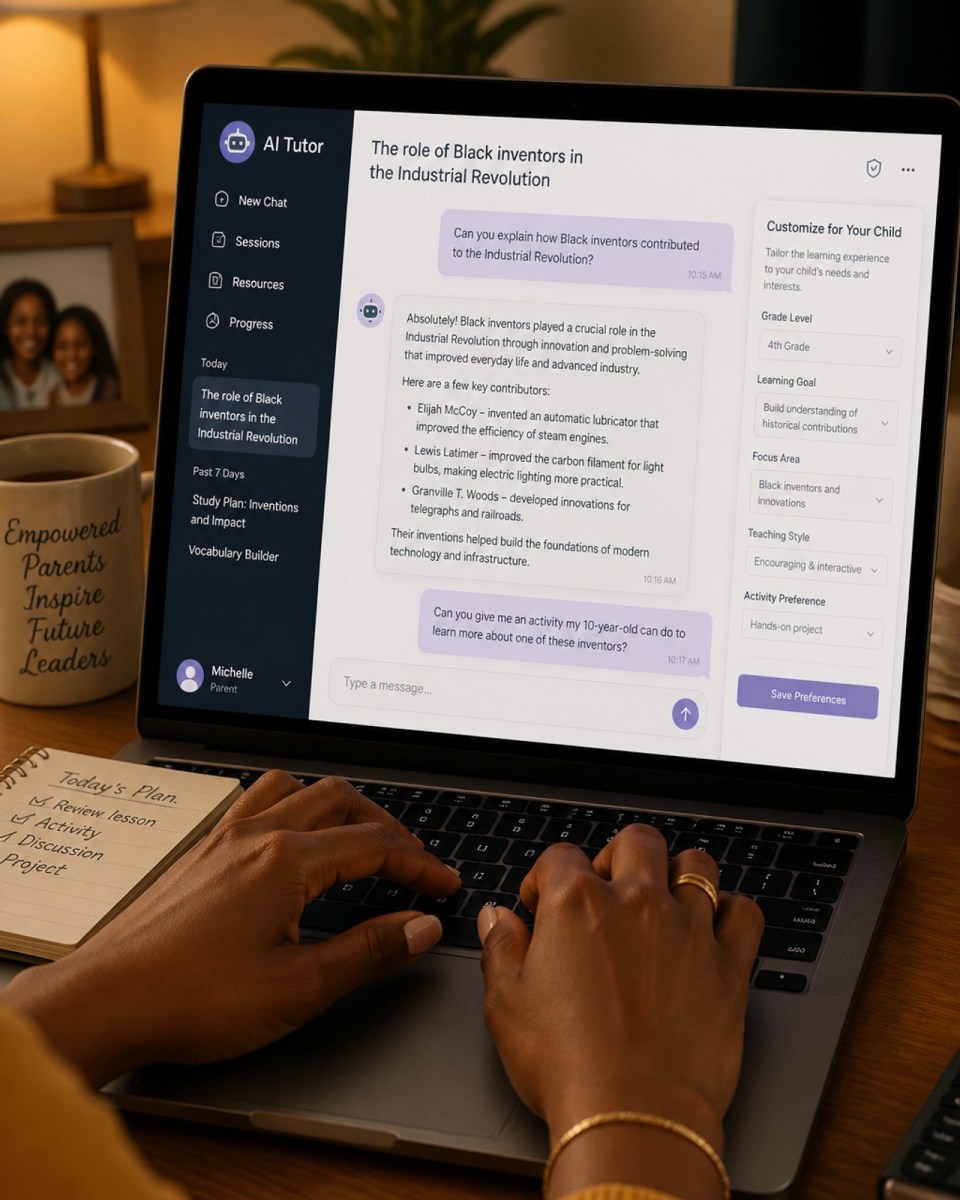
At Successful Black Parenting Magazine, we are committed to being your guide through this technological revolution. We celebrate the brilliance of our children and the dedication of our parents. By mastering these tools today, we are ensuring that the leaders, scientists, and creators of tomorrow have everything they need to thrive.
The future isn't just coming; it's already here, and it looks exactly like the brilliant child sitting at your kitchen table right now. With a little guidance and the right AI "partner," there is no limit to what they can achieve.
Frequently Asked Questions About Free AI Tutors
Are free AI tutors safe for kids?
They can be, with supervision. Check each tool’s age rules, keep personal details out of chats, and sit with younger children while they use it.
Can free AI tutors replace a human tutor?
Not fully. Free AI tutors are great for practice and quick explanations, but a teacher or tutor can spot gaps, build confidence and notice when something is really wrong.
How much time should my child spend with an AI tutor?
Short, regular sessions work best. Try 15 to 20 minutes on a set schedule, then ask your child to explain what they learned in their own words.












comments +