


Every June, America scrambles to wrap up grills, gadgets, and gift cards, but a growing body of research suggests Black fathers have quietly been asking for something entirely different all along. With Father’s Day 2026 arriving on June 21, new survey data confirms what many Black families already know in their bones: the best gift you can give a Black dad this year cannot be purchased, wrapped, or shipped overnight.
This is not a feel-good suggestion. This is what the numbers say, and once you see them, the way you celebrate Father’s Day in your home may never look the same.
Black fathers are not failing their families. Our Father’s Day traditions may be failing Black fathers.
The Quiet Revolution Nobody Is Covering
Black fatherhood is living through a quiet revolution, one that mainstream culture has been slow to recognize. A landmark study from the CDC’s National Center for Health Statistics found that Black fathers are the most involved dads in America when it comes to daily caregiving, outpacing white and Hispanic fathers in bathing, feeding, reading to, and playing with their children every single day.
And yet the cultural script around Black fatherhood still lags dangerously behind the reality. The “absent Black father” myth widely challenged by sociologists and researchers at outlets including Newsweek, continues to shape how Black dads are portrayed, celebrated, and, crucially, how they are valued at home. When a man shows up every day but still feels invisible, something is broken in how we honor him.
What the Data Actually Says About Black Dads
The CDC’s National Health Statistics Report No. 71, which analyzed data from more than 10,000 fathers across the United States, found the following daily involvement rates:
| Daily Parenting Activity | Black Fathers | White Fathers | Hispanic Fathers |
|---|---|---|---|
| Bathed, dressed, or diapered children | 70% | 60% | 45% |
| Ate meals with children | 78% | 74% | 64% |
| Took children to activities | 27% | 20% | 22% |
| Helped with homework | 35% | 28% | 22% |
Additionally, Pew Research data shows that 67% of Black fathers who do not live with their children still see them at least once a month, a figure higher than that of white fathers in the same living situation. These are not absent men. These are present, intentional fathers who have been swimming upstream against a narrative that was never built for them.
Black fathers outpace every other group in daily hands-on caregiving, and most people have never heard that fact stated plainly.
Why Father’s Day Keeps Missing the Mark
So if Black dads are showing up this consistently, every bath, every homework session, every school drop-off, why does Father’s Day so often feel like an afterthought? Walk into any store in June, and you will find a sea of “#1 Dad” mugs, novelty socks, and yes, another tie. These gifts are fine. But they are also generic, and generic is not the same as seen.
The disconnect runs deeper than retail. It lives in the silence around what Black fathers carry emotionally. Many Black dads were raised in a tradition of “strong and silent” of providing without asking for much in return. They showed up. They worked. They protected. But somewhere along the way, the cultural conversation around emotional acknowledgment in Black fatherhood got skipped entirely. And their children are paying close attention.
Children Need More Than a Dad in the House
Researchers have spent decades studying father involvement, and the findings are unambiguous. A comprehensive systematic review of longitudinal studies published in the peer-reviewed journal Acta Paediatrica found that engaged, emotionally present fathers are directly linked to better cognitive development, lower rates of behavioral problems, and stronger emotional regulation in children, outcomes that follow kids well into adulthood.
Critically, the research found that it is not the quantity of time alone that matters most, it is the quality of the emotional connection. This matters enormously for Black families, who thanks to systemic economic pressure, workplace stress, and the psychological weight of navigating racism daily, often have fathers running on empty by the time Father’s Day arrives. The question is not whether Black dads are present. The question is: are we filling their cup so they can keep filling ours?
Children with emotionally engaged fathers show measurably better outcomes in school, mental health, and relationships, regardless of household income or living arrangements.
When Was the Last Time Someone Really Saw Him?
Here is the part most Father’s Day articles skip entirely. Many Black fathers, even the deeply involved ones, have rarely, if ever, been told clearly and specifically: I see what you do. I see who you are. You are enough.
A 2025 YouGov survey of 502 American fathers found that 56% of dads say Father’s Day is best spent with their children not at a store, not unwrapping presents, but together. A striking 32% said they did not want any gifts at all. As The Washington Times reported, American dads increasingly prefer presence over present, a trend even more pronounced in communities where emotional acknowledgment has historically been undervalued.
When was the last time someone told the Black dad in your life, specifically and out loud, exactly what his presence has meant?
So what does a Black dad actually want this Father’s Day? Keep reading because the answer might permanently change how your family celebrates.
Three Things That Cost Nothing and Mean Everything
1. To Be Specifically Seen
Not a generic “Happy Father’s Day, Dad,” but something real: “Dad, I noticed how you drove me to practice every Thursday even when you were exhausted, and that meant everything to me.” Specificity is love made visible. Black fathers who operate in a culture that often renders them invisible need, and deserve, to hear their individual contributions named out loud.
2. One Full Day of Rest
18% of fathers specifically said they want free time to spend however they like on Father’s Day. For Black dads carrying professional, emotional, and community loads simultaneously, an unscheduled afternoon with zero obligations is genuinely radical self-care. Let him choose, and protect that time like an appointment.
3. A Letter, Not a Card
Unlike a store-bought card, a personal letter forces the writer to articulate something true. A real letter, one that names specific memories, specific qualities, specific gratitude, creates something a father can return to on hard days. It costs nothing and outlasts every material gift.
The Presence Parenting Father’s Day Method
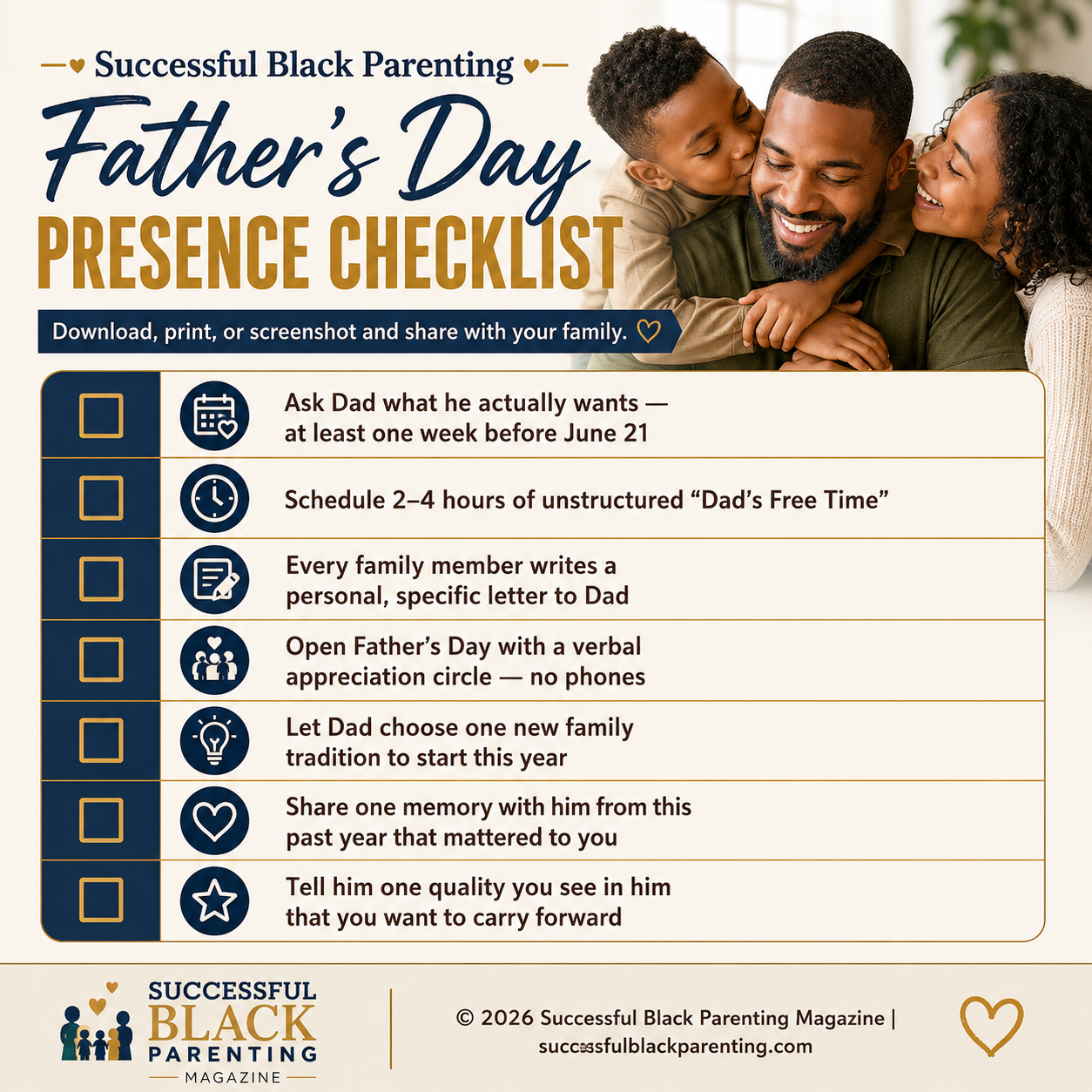
- Start the day with words, not things. Gather the family and let each person share one specific thing they appreciate about Dad. Make eye contact. Mean it.
- Ask him what he actually wants. Ask at least a week before so he has time to think, then do exactly that.
- Give him unstructured time. Block off two to four hours on his schedule that are entirely his. No errands, no kids, no obligations.
- Write the letter. Every child old enough to hold a pencil should write one. Keep them. Let Dad keep them.
- Create one new family tradition together. A playlist, a meal, or an annual photo in the same spot. Traditions communicate permanence, and permanence communicates love.
| Traditional Father’s Day | Presence Parenting Method |
|---|---|
| Store-bought card with someone else’s words | Personal letter naming specific memories and qualities |
| A day full of plans and obligations | 2–4 hours of fully unstructured Dad’s Free Time |
| Generic last-minute gift | Asking what he wants, and doing exactly that |
| One-time celebration | A new annual tradition he helps create |
| Appreciated in passing | Appreciated specifically, out loud, by each family member |
- CDC data confirms Black fathers are the most involved dads in America by virtually every daily caregiving measure.
- 56% of fathers say quality time with family is what they want most for Father’s Day, not gifts.
- Emotional recognition is the most underdelivered gift in Black households on Father’s Day.
- Research confirms emotionally engaged fathers produce measurably better outcomes for children’s cognitive and emotional development.
- The SBP Presence Parenting Father’s Day Method gives families a five-step framework for a celebration that actually lands.
Your Questions, Answered
Are Black fathers really more involved than other groups?
The CDC’s National Health Statistics Report No. 71 analyzed data from over 10,000 fathers and found Black fathers outpaced white and Hispanic fathers in daily caregiving including bathing, feeding, reading to, and playing with their children.
What if we cannot afford a big Father’s Day celebration?
The research works in your favor. YouGov’s 2025 survey found the majority of dads prefer time together over any material gift. A handwritten letter and a few unscheduled hours cost nothing and rate as more meaningful than purchased gifts.
How do I get my kids to write a meaningful Father’s Day letter?
Give them a prompt: “Write about one time Dad showed up for you when it mattered, and how it made you feel.” For younger children, have them dictate while you write, then let them illustrate it. Specificity is what makes it memorable.
What is the Presence Parenting Father’s Day Method?
Presence Parenting is a Successful Black Parenting framework for intentional, emotionally engaged family connection. On Father’s Day, it flips the dynamic. The family gives their full attention to Dad.
Why does emotional acknowledgment matter so much for Black fathers specifically?
Black fathers navigate a cultural environment that has historically minimized their contributions to family life. Research shows that feeling seen and valued is directly tied to sustained engagement and mental health, and that ripples outward into every interaction they have with their children.
The Tie Can Wait. The Words Cannot.
Black fathers have been doing the work quietly, consistently, and often without adequate acknowledgment. This Father’s Day, the most powerful thing a family can do is close the gap between how much Black dads give and how rarely they hear that it has been noticed.
The tie can wait. The words cannot.
© 2026 Successful Black Parenting Magazine. All rights reserved. This article is for informational and editorial purposes only. Always consult a licensed professional for personalized guidance on family wellness and mental health.













comments +