

By Terence Lester, PhD
In 2021, TEDx Collier Heights invited me to give a talk titled “The Talk: Preserving Joy for Black Children.” In it, I explored how Black children receive talks about how to navigate the world when they are Black, and how Black children, according to research, are aware of race at earlier ages because of racism and anti-Blackness.

The talk includes anything from how to handle police encounters, to what to do when you are out in public being stereotyped, to how to try to protect your body from racial violence. Reflecting on this topic made me think about my own experience with the talk. I shared that when I was ten, I first encountered it by hearing my grandfather tell the story of Emmett Till. That moment is one I will never forget. He sat me down and said something that shaped my life:
“This world will be hard, and you will be mistreated because of the color of your skin. But remember, you always have your family,” as he often reminded me in moments that shaped my identity, a sentiment echoed in themes explored in my TEDx message.
The Weight of Fear in Generational Conversations
That was my first version of the talk. I imagine my grandfather heard a similar warning when he was growing up during Jim Crow. I thank my late grandfather, Herman Lester Sr., for those words because they shaped me. But when I reflected on the talk as a whole, I noticed it almost always contained more fear than joy.
In fact, receiving the talk from my community made me realize this in its entirety. Whether it was from my mother, coaches, uncles, community members, or my father, it was always heavy. I know they meant well, but I think it was heavy because you are thrust into a racial conversation long before your brain has the time to develop fully, even to comprehend what type of world you are entering into as a Black child. Those conversations were, in most cases, random and carried a heightened sense of racial terror connected to our collective Black history.
I also noticed that most of those conversations did not end on an uplifting note, with words like “You are powerful, worthy, and your Blackness is something to celebrate,” a truth I later affirmed through deeper reflection and public conversation in my TEDx Talk. Or at least for the talks I received, they didn’t. It was more about what to avoid and how to be safe. That kind of fear etches itself into your memory, and it is probably the reason I feel those raw emotions every time I get pulled over by a police officer, experience discrimination, or see racial violence happen to someone who looks like me on the news or social media.
“…my fatherhood journey taught me that my everyday interactions with my children must be dedicated to lifting them up, centering as much joy as possible, while ensuring that they constantly see positive images of Black joy and success.”
Why Centering Black Joy is an Act of Resistance
It is also the reason I partially titled the TEDx Talk Preserving Joy for Black Children. I spoke about what that fear taught me and how I show up for my children with my words because I learned from those talks that words carry power. The words we speak as parents can warn, but they also can wound or heal. And that is just as true individually and collectively.
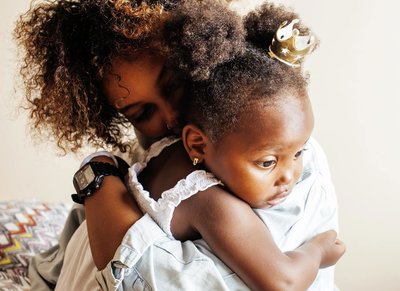
I understood this even more deeply when my children were born, realizing that my version of talking to them about the state of the world could not be only about protection. It had to be about building them up with joy. I knew from my history with the talk that I wanted my children to feel joy before they ever had to carry the weight of injustice. Not because I planned to lie to them or shield them from reality, but because, as their father, I refused to let fear be the center of our conversations.
A Father’s Commitment to Raising Joyful, Confident Black Children
That is not to excuse the fear I feel in raising Black children and wanting to keep them safe in a world that might use their skin to determine how they are treated. But I believe that joy is an act of resistance. Therefore, my fatherhood journey taught me that my everyday interactions with my children must be dedicated to lifting them up, centering as much joy as possible, while ensuring that they constantly see positive images of Black joy and success. This is everything to me because I want to make sure they know that our collective history did not begin in chains or with racism.
This commitment has given me the opportunity to tell them every day that I love them deeply and that they are the beloved of God. I learned that there is something powerful when a Black child hears from their father every single day, “I love you.” I have seen firsthand how it removes the sting of what it means to be in a Black body.
Rewriting the Narrative of Protection Through Love
As my children get older, I want my talk to constantly center on how unique and gifted they are and encourage them to lean into that uniqueness to take up space in a world that will attempt to shrink their Blackness. I make sure they not only see a healthy marriage between their mother and me, but also that joy is normalized in the life we get to experience together. I do not care if it is simply eating dinner or joking with one another; each interaction, for me, is to resist anything that would attempt to steal their joy.
So long before they step out the door and experience what could be a world filled with sorrow, joy comes first in the way that I choose to father them. Not out of naivety, but because as a Black father, I know race, injustice, and awareness will always be a part of my parenting, and I refuse to let those be the only stories my children inherit.
Why? Because I remember the fear I felt after the talks I received. And while they prepared me, I have spent most of my adult life fighting to reclaim my joy. I do not want my children to have to fight for theirs.

Dr. Terence Lester is a storyteller, public scholar, speaker, community activist, and author of From Dropout to Doctorate. He is the founder and executive director of Love Beyond Walls, a nonprofit organization focused on raising awareness about poverty, homelessness, and community mobilization. He serves as the director of public policy and social change and as a professor at Simmons College of Kentucky (HBCU). He received his PhD with a concentration in public policy and social change from Union Institute and University. Terence is known for nationwide campaigns that bring awareness to homelessness, poverty, and economic inequality. Terence is happily married to his best friend, Cecilia, and they have two amazing children, Zion Joy and Terence II.












comments +